By the Numbers
- 12
- agents in my personal setup at the peak. I was really using one or two.
- 15×
- tokens a multi-agent system uses compared with a chat (Anthropic, June 2025)
- 3
- questions in the skill-first test, asked before anyone builds a new agent
Listen
7 min · Audio coming soon
The Brief
Forward this. Then decide if the essay is worth your time.
- 01
0:00 · What I thought in March
I wrote a field guide to the enterprise agent graveyard. At the same time I was filling one at home.
- 02
0:01 · An agent for everything
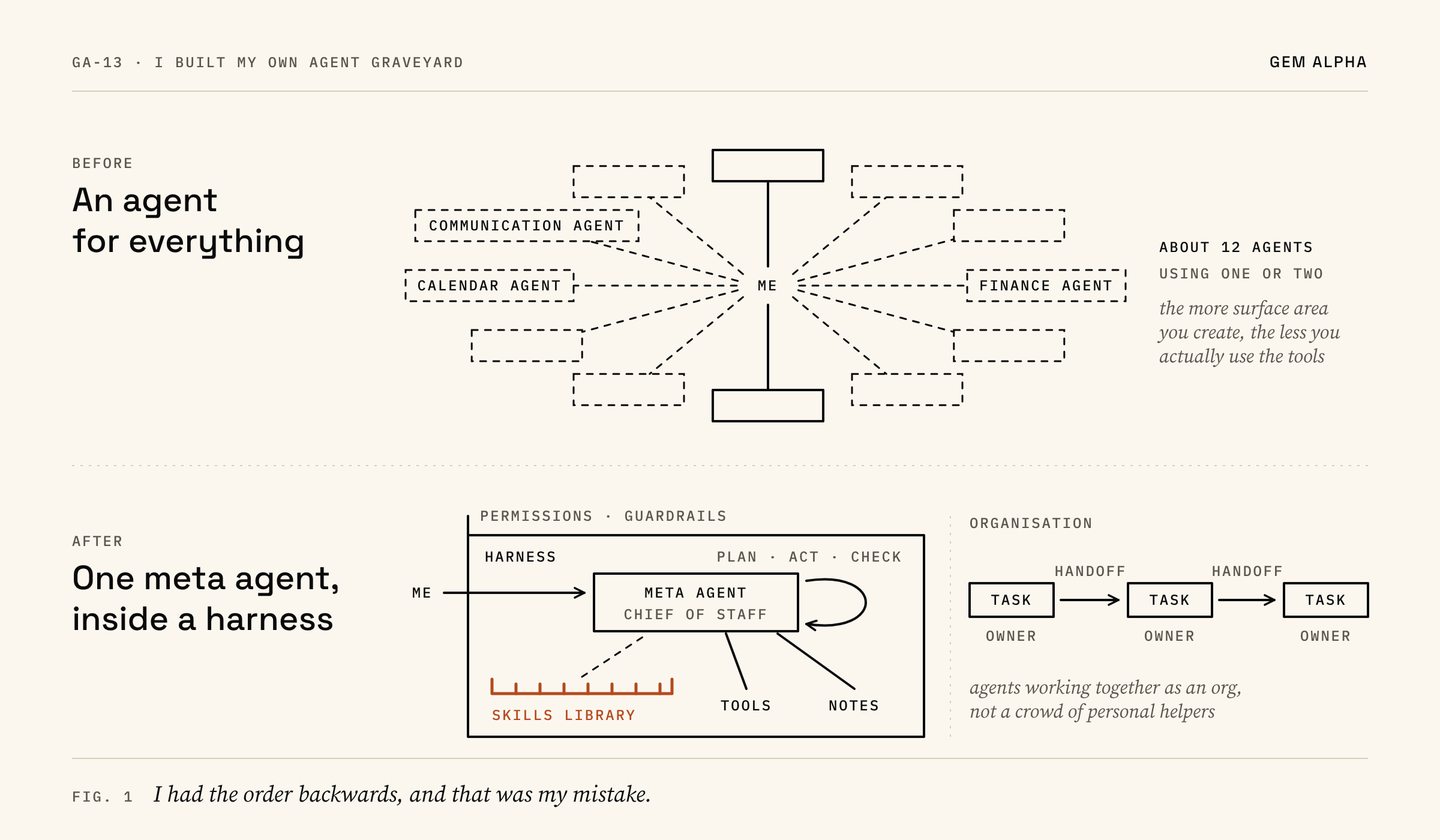
About 12 agents, and I was really using one or two. I spent more time fixing them than getting value back. The more surface you create, the less you use the tools.
- 03
0:02 · One meta agent, inside a harness
A meta agent sits across everything and calls the right skill. The harness is what it runs inside: the loop, the memory, the skills and tools, and the guardrails.
- 04
0:03 · Same logic, at work
Separate agents earn their place when they are scoped to a task and hand off like a team. At work, one reusable Copilot assistant preps every meeting in my day.
- 05
0:04 · Count curiosity, not agents
The skill-first test, and a better measure: how many people found a new way of working.
Essay
In March I wrote a field guide to the enterprise agent graveyard. It is still up as what I thought in March. It named the residents: the Demo Darling that nobody maintains, the Doppelgänger that gives the board a second number, the Ghost still running on a shared account. It ended with five rules, and a line I still like: the winners will not be the ones that built the most agents, but the ones that killed the right ones.
I meant every word. What I did not say was that I was building my own graveyard at home at the same time.
This is the update. For one person, the unit of AI is not the agent. It is one meta agent running inside a harness, calling a library of skills. Separate agents earn their place only inside an organisation, where each one is scoped to a task and hands off to the next like a team. And the measure of success is not how many agents you built. It is how many people got curious and found a new way of working.
An agent for everything
My early setup had an agent for everything. A calendar agent. A finance agent. A communication agent. Each new job got a new agent, because that was how I thought about it. Agents first, then skills, then the harness they run in, if I thought about the harness at all.
At the peak I had about 12 agents. The moment I realised was not dramatic. I looked at what I actually used, and it was one or two of them. The rest needed fixing more often than they gave anything back. I was spending more time maintaining agents than getting value out of them.
In Lean terms, I had built inventory. Each agent sat on the shelf, cost attention to hold and hid problems. By my own March field guide I was running a small graveyard. I had the order backwards, and that was my mistake.
So I changed the shape. Instead of twelve specialists, I wanted something closer to a good executive assistant: one agent with a combined view of my week, and skills it runs as playbooks. My calendar alone became far easier to manage.
The big lesson was about surface area. The more surface area you create, the less you actually use the tools. Less to look after means more time using what is there. A laser focus beats a full shelf.
One meta agent, inside a harness
That executive assistant is now my meta agent: one agent that sits across everything, sees the whole picture and calls the right skill. It acts as my chief of staff. Behind it sits a shared library of reusable skills that any agent can run.
I used to treat the harness as an extra, something for deep work on my laptop. I had that wrong too. As LangChain put it in March 2026, an agent is a model plus a harness. The model does the thinking. The harness is everything around it. It runs the loop of plan, act and check. It decides what goes into the model's limited working memory at each step, loads a skill only when the job needs it, and calls the tools. It keeps the notes that carry over between sessions, and it enforces the permissions and guardrails.
In logistics terms, the model is the operator and the harness is the site: the conveyors, the scanners, the guards and the standard work. A good operator on a bad site still has a bad shift.
So the order that works is the reverse of my early habit. Harness first, then skills, then agents. Get those two right, and one meta agent does most of what twelve agents tried to do.
A skill is not another agent. It is a written procedure the harness loads into the meta agent's working memory when a job calls for it. Lean people would call it standard work: the steps, the inputs, the checks and what done looks like, written once and improved each time it runs.
I am not the only one who got here. Anthropic released Agent Skills in October 2025 as folders of instructions an agent loads on demand, and opened it as a standard in December, with Microsoft adopting it in VS Code and GitHub. In September 2026 Microsoft's Agent Framework team put the shift in one line: "Move the specialist's instructions, not another model, into the orchestrator." That is the lesson my calendar agent taught me, in an engineering blog.
Same logic, at work
So are many agents always wrong? No. My view now is plain. One super agent makes sense for personal use. Multiple agents only add value when you are running a business or an organisation.
The research backs the distinction. Anthropic's write-up of its multi-agent research system, from June 2025, describes a lead agent that delegates to specialised subagents working in parallel. It also reports that multi-agent systems use about 15 times the tokens of a chat. They pay off only when the task is worth that much.
That changes how I read my March creatures. Most of them were personal assistants that had wandered into the enterprise. They were built around one person's convenience, not a task in a process. A good organisational agent looks more like a station on a sort floor. It has one job, a clear handoff in, a clear handoff out and someone who owns it. Agents working together as an org, not a crowd of personal helpers.
I applied the same logic to Microsoft 365 Copilot at work, and I am getting more out of it. The most valuable thing I have set up is one digital assistant I reuse every day. Each day it produces an HTML plan for my day. It looks at my calendar, my Planner and the tasks due today and tomorrow, and it flags the risk of things not getting done.
The part I value most is meeting prep. For each meeting in my day, it goes into email, Teams messages and documents and does the preparation for me. That helps me be the most prepared person in the room.
The old me would have built a calendar agent, a task agent and a meeting agent. Now it is one assistant running one playbook, the same lesson my 12 agents taught me at home.
The platforms are catching up on the enterprise side too. Microsoft's Agent 365 registry, generally available since May 2026, shows admins a count of agents without owners. The graveyard now has a counter built in. What you do with the number is still a leadership call.
Count curiosity, not agents
Here is the test I now use before anyone builds a new agent, at home or at work. Three questions, ten minutes:
- Could the meta agent do this with a new skill? If yes, write the skill.
- Is this a task other people hand work to and from? If not, it is personal, and it is a skill.
- Who owns it, and when does it die? Name one person and set a sunset date no more than 90 days out.
Most ideas stop at question one, and that is the point.
The measure changed too. In March I said the metric that matters is agents delivering value. I would go further now. Success is people's curiosity, and the new ways of working they find. It is why my weekly team newsletter, Five Minutes & Coffee, teaches skills people can use in the Copilot they already have, not new agents to build. A team that built nothing new but changed how it runs a weekly report has done more than a team with ten new agents nobody opens.
There are honest limits. One meta agent can become my own Oracle: genuinely useful, and understood by one person. A skills library can turn into a graveyard as well, so the red tag applies to skills too. And curiosity is harder to count than agents. I would still rather count the right thing badly than the wrong thing well.
What is the next agent you were about to build, and could it be a skill instead?
Related
Want the next edition? Join the newsletter. No modal. No auto-send.

Ruby Wolff
Gem Alpha. Shipping in public. Builder notes, not a news desk.
Personal opinion on leadership. Not the view of my employer.