By the Numbers
- 5
- habits I use AI to build
- 1
- end-of-day verbal journal, straight into my memory vault
Listen
8 min · Audio coming soon
The Brief
Forward this. Then decide if the essay is worth your time.
- 01
0:00 · Contracts in the back of an Uber
Today you can review and sign a contract in an Uber on the way to the airport. The expectation is speed.
- 02
0:01 · What the job actually is
Clear direction, safe guardrails, decisions made rather than sat on. None of that can be automated.
- 03
0:02 · Five habits, not five tools
Me first, a weekly priority plan, a protected calendar, a classifier to say no, and a reflection.
- 04
0:03 · Talking to my computer
End-of-day verbal journaling into my memory vault. Long pauses aren't uncomfortable, so I think before I speak.
- 05
0:04 · The honest caveat
Consuming more is not the same as understanding more. But I have big days and moments of quiet.
Essay
"What is the bravest thing you've ever said?" asked the boy. "Help," said the horse.
I keep coming back to that line from Charlie Mackesy's The Boy, the Mole, the Fox and the Horse. On the surface it is a children's book. Underneath it asks how you move through uncertainty without losing your humanity. That is the question I think leaders are facing right now, only faster.
In The Paradox of Progress I wrote about holding competing truths. This one is about the person doing the holding. My argument is simple. The age of AI doesn't reduce the importance of human leadership. It increases it.
Contracts in the back of an Uber
I was listening to a senior executive recently, talking about a conversation with his father, who is in his nineties. He said it is quite amazing that today you can review and sign a contract in an Uber on the way to the airport, through DocuSign on your phone.
Rewind a few decades and that decision happened with pen and paper, in a room, with time set aside to read the documents.
There is still governance leading up to the signature. Nobody is signing blind. But the expectation has changed. The expectation is speed.
That is one of those multiple truths. As leaders we are expected to do a lot more than we were 20 or 30 years ago. We consume more information than we ever have. We make more decisions, more often, on the move. And at some point the obvious question arrives: when does your effectiveness as a leader start to dissipate?
I don't think the answer is to push back on the speed. It isn't going away. I think the answer is to be much more deliberate about where your attention goes.
What the job actually is
Strip it back and a leader's key job is not complicated.
Mobilise the team and give them absolutely clear direction. Keep them safe inside the guardrails of that direction, so they know where the edges are and can move with confidence inside them. Think of it as a compass, not a map. And make decisions. Don't sit on them.
None of that can be automated. A tool can draft the options, summarise the paper and flag the risks. It cannot decide what the team is for, or carry the accountability when the call is wrong.
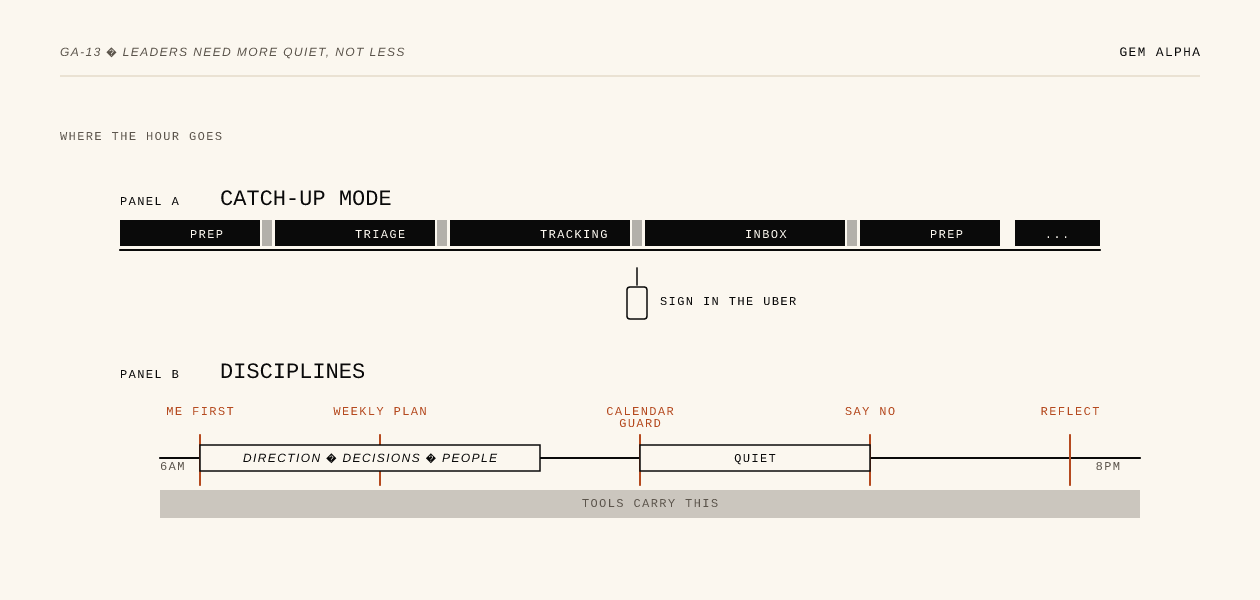
But a lot of what fills a leader's day is not that job. It is preparation, triage, tracking and catching up. Used correctly, this technology can take over the tasks a leader can automate and should automate. Then it is up to me to use the time wisely, and give it back to the people I lead.
That is why I say AI makes leadership matter more. When the machine carries more of the middle, what is left is the human part: direction, judgment, decisions and people. There is nowhere to hide behind the busywork.
Five habits, not five tools
What surprised me is that the tools mattered less than the habits they helped me build. Here are the five I rely on.
1. Start the day with me first. Before the inbox gets a vote, I look at what I need to think about and prepare for. My day starts with my priorities, not everyone else's.
2. Design a weekly priority plan, and keep track of it. Writing priorities down is easy. Keeping them in view on a Wednesday afternoon is hard. The tool does the tracking so I don't drift.
3. Protect my calendar. It gives me insight into my energy levels and the risks in the week ahead, such as back-to-back days with no thinking time, before I am in the middle of them.
4. Use it as a classifier to say no. I can hold a request up against my priorities and ask a plain question: is this aligned? If it isn't, it is much easier to say no, or not now, with a clear reason.
5. Build a reflection. Daily or weekly, a short look back at what happened, what I decided and what I would do differently.
Talking to my computer
The fifth habit is the one I didn't plan.
When I started this AI journey, my intention was to build a second brain. A second brain needs captured memories and thoughts, otherwise it is an empty filing room. So I thought, I'll just talk to my computer at the end of each day, or whenever an idea pops into my head, and lock it down into markdown files.
That has now become a habit. At the end of the day I do verbal journaling. I talk to my computer or my phone, and it pushes what I say into my memory vault. Over time it builds a network of my memories, linked to each other. To be honest, that is pretty damn awesome.
I am now starting to realise why so many thought leaders talk about journaling. The act of it helps you distil your thoughts. It certainly does for me. I reflect on things as I talk them through, and I go a little further than I would have in my head.
There is one benefit I didn't expect. When you talk to a computer, long pauses aren't uncomfortable. Nobody is waiting for you to fill the silence. So you can stop, think about what you actually want to say, and then say it.
As leaders, we really should be thinking more. Not reacting more. Thinking.
The honest caveat
I don't think these tools reduce my intelligence. They let me consume more. Whether I retain all of it is another question, and I don't want to pretend otherwise. Consuming more is not the same as understanding more, and I am still working out where that line sits.
What I can say is that I feel like I am doing more thinking, because I am not in catch-up mode. I have big days like most executives do. But I also have moments of quiet. That isn't luck, and it isn't a lighter job. It is because I have built some disciplines using these tools.
That is the trade I would encourage any leader to make. Let the tools carry the preparation, the tracking and the first pass. Take the time back, and spend it on the parts only you can do: clear direction, safe guardrails, decisions made rather than sat on, and some actual quiet to think.
Back to the horse. The bravest thing isn't pretending you can consume everything and decide everything alone. It is asking for help, and using it well.
So here is a question for your week. If a tool gave you back one hour tomorrow, what would you do with it, and would your team notice?
Related
Want the next edition? Join the newsletter. No modal. No auto-send.

Ruby Wolff
Gem Alpha. Shipping in public. Builder notes, not a news desk.
Personal opinion on leadership. Not the view of my employer.